Protecting heat exchangers from the outside in
Si 14 EG
When it comes to heat exchanger protection, internal lining tends to attract most of the attention, and for good reason. But external surfaces are often equally exposed to corrosion, condensation, and aggressive atmospheres. SÄKAPHEN and its authorized applicators have the products and processes to address that too.
When external protection is the priority
Heat exchangers operating in marine environments, chemical plants, or humid industrial settings face continuous shell-side exposure to corrosive conditions. Also on non-insulated equipment, the challenge is compounded by water vapor diffusion: a temperature differential exceeding 30 °C between the coated surface and the surrounding environment is sufficient to drive vapor through a standard lining film, compromising its integrity over time. Selecting the right coating system for these conditions requires the same engineering rigor applied to internal lining projects.
Products and processes for the external coating of heat exchangers
SÄKAPHEN’s product range and applicator network are equipped to address shell-side heat exchanger tube protection with the same technical depth applied to internal lining projects. Product selection is driven by the specific combination of chemical exposure, operating temperature, and thermal cycling that characterizes each application.
A project example
A recent project carried out by Donelli, SÄKAPHEN’s Italian authorized applicator, demonstrates how external heat exchanger coating works in practice.
Scope:
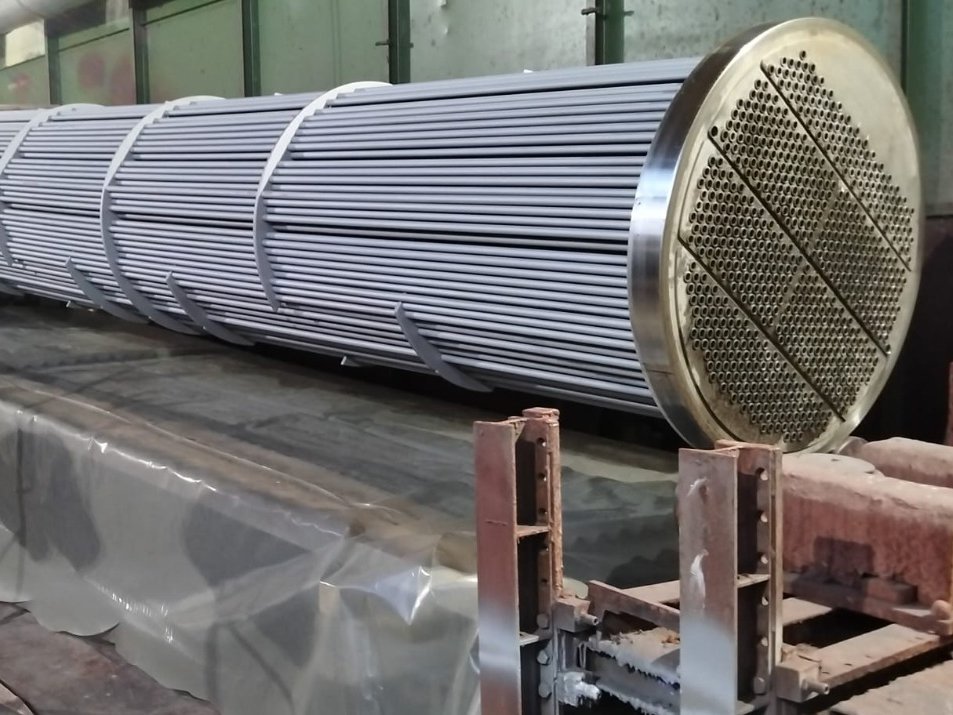
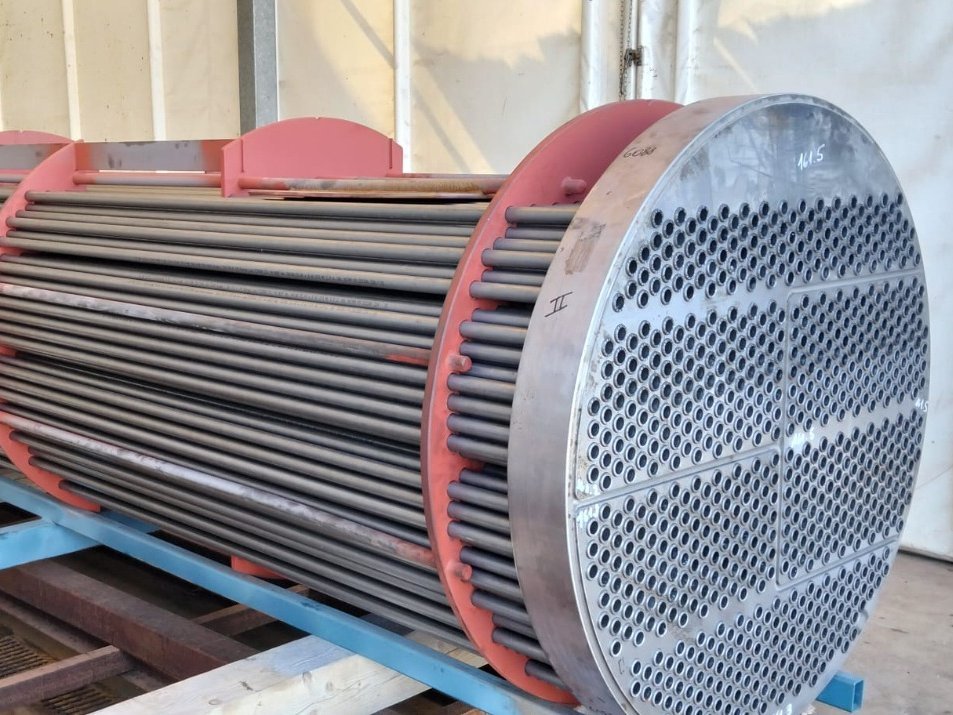
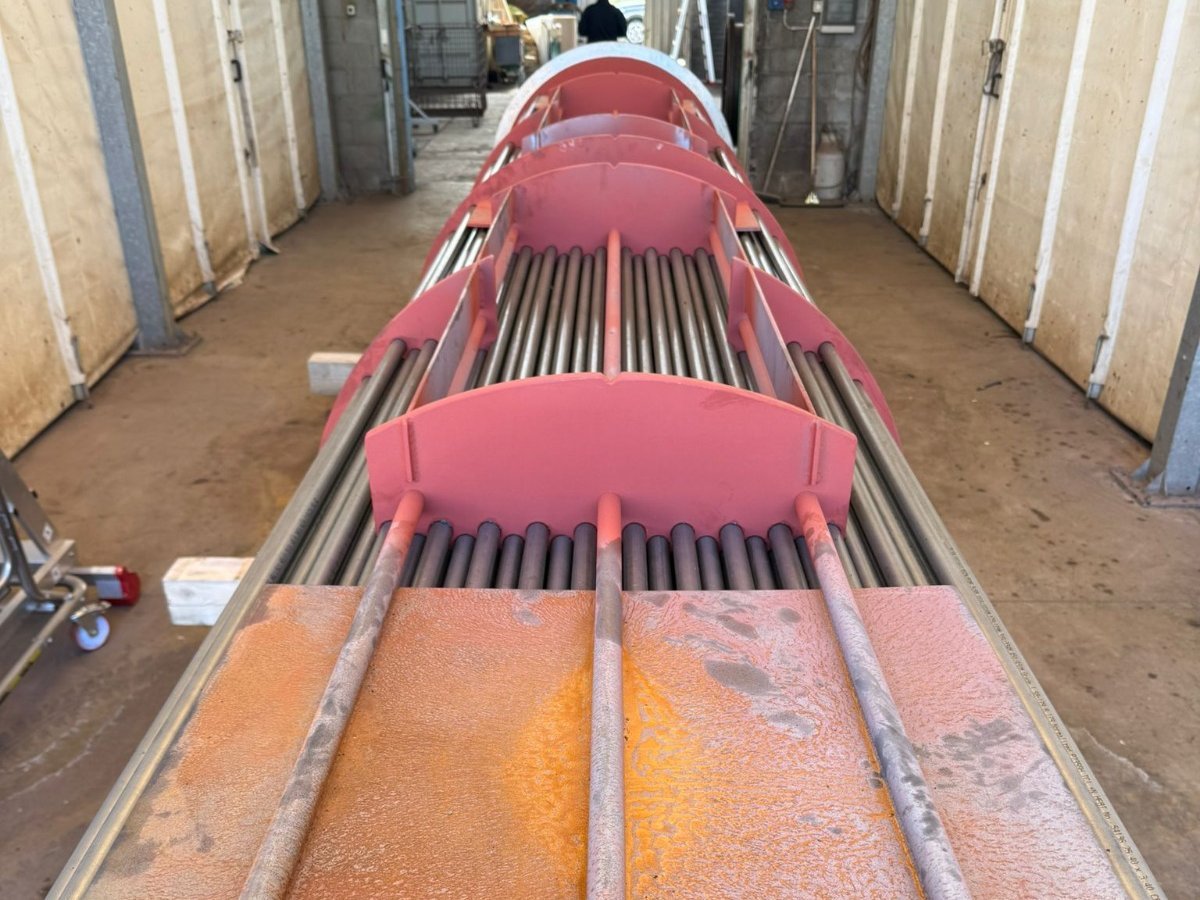
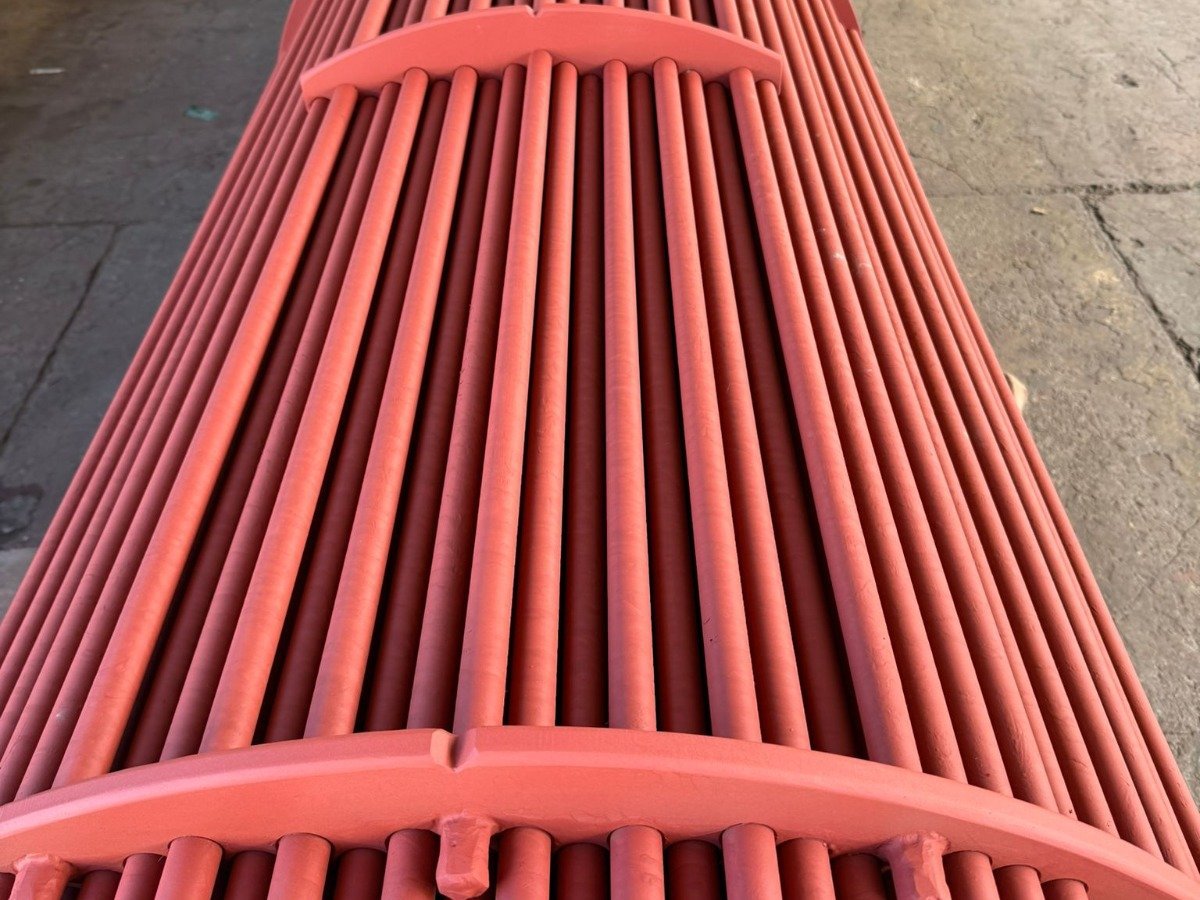
External coating of a heat exchanger tubes, baffles, and structural cage.
The tubes were coated by flooding to ensure complete, uniform coverage of every external surface.
Product:
SÄKAPHEN Si 14 EG
For external surfaces on non-insulated equipment where vapor diffusion resistance is a primary requirement, Si 14 EG is a particularly well-suited solution. This single-component, self-priming, heat-cured phenolic lining is applied directly to metal and engineered to resist water vapor diffusion across temperature differentials up to 85 °C. Its chemical resistance extends to acidic to mildly alkaline aqueous media, process gases, solvents, and all types of cooling water, and the hard-elastic film tolerates temperature fluctuations well.
Sequence:
1. Cage and baffles coated by the applicator before tube insertion.
2. Unit returned to the heat exchanger manufacturer for tube bundle assembly.
3. Fully assembled unit returned to the applicator for a second coating phase, covering all external surfaces of the complete assembly.
The two-phase sequence required close coordination among the applicator, the manufacturer, and SÄKAPHEN’s technical team. The result was a fully protected unit delivered to specification, with no uncoated or compromised surfaces at any external joint or interface.
Get in touch
SÄKAPHEN’s technical team is available to advise on product selection, application sequencing, and quality assurance for both external and internal heat exchanger coating projects. Contact us to discuss your requirements: SÄKAPHEN is happy to support.
FAQ
1) Can the external coating of heat exchanger components be carried out before final assembly?
Yes, in some cases this is the preferred approach. As the project example illustrates, coating the cage, baffles, and if applicable, individual tubes before the bundle is assembled provides full control over film thickness and integrity on every surface. A second coating phase after assembly then ensures complete protection across all external joints and interfaces as well as tubes.
2) What causes water vapor diffusion through external heat exchanger coatings, and how can it be prevented?
On non-insulated equipment, a temperature differential exceeding 30 °C between the coated surface and the surrounding environment can drive vapor through a standard lining film. Si 14 EG is engineered to resist this phenomenon at differentials up to 85 °C without requiring excessive dry film thickness.
3) Which industries typically require shell-side coating of heat exchanger tubes?
External coating is most commonly specified for heat exchangers operating in marine environments, offshore installations, chemical processing plants, and humid industrial settings, as well as in any location where external surfaces are exposed to corrosive atmospheres, condensation, or aggressive process conditions. A particularly interesting application is reflux condensers in crude oil refining, which play a critical role in condensing vapor rising from the distillation column and returning liquid to the process; the combination of thermal cycling, hydrocarbon exposure, and condensation makes robust external protection essential. Pre-heating of crude oil is another typical use case with comparable demands.